GenBridge
Not too young to listen, not too old to learn.

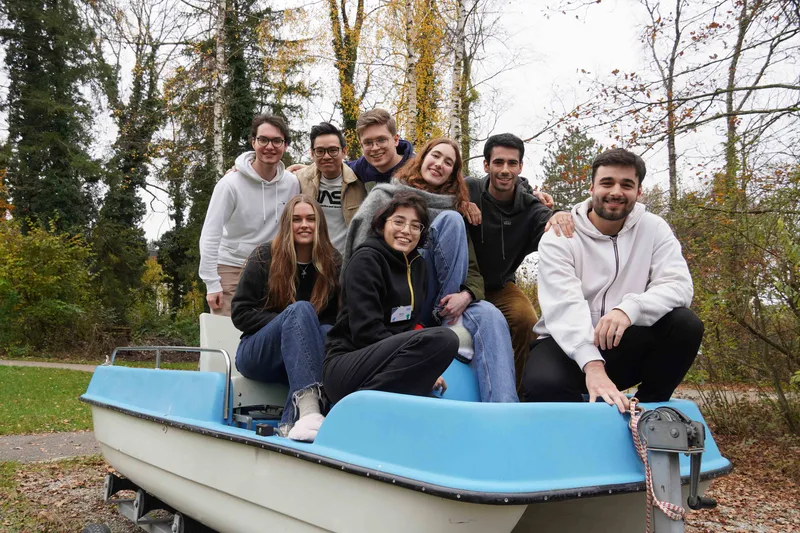
GenBridge is an interdisciplinary team of TUM: Junge Akademie #class25 aiming to connect students and recently retired professionals through meaningful research-informed relationships. Our goal is to bridge generations using technology, human connection, and data-driven matching, fostering growth, learning, and mutual respect.
Why this matters
Each year, companies lose critical tactical knowledge as experts retire, stalling innovation and efficiency. Meanwhile, older adults report rising social isolation and declining self-esteem, while students often lack access to real-world mentoring. In cities like Munich, generations often live side by side without truly meeting. Different routines, different spaces, different rhythms. The distance is rarely visible. But it is there.
Our Approach
Our solution is a structured intergenerational mentoring programme that pairs students with experienced retirees, grounded in research on self-disclosure and intergenerational learning. Pairs receive discussion prompts rooted in the 36-question procedure introduced by Aron et al. (1997) for increasing social connection, adapted to focus on generational perspectives.
The Event

On a bright Sunday afternoon on July 20, 2025, students and older adults gathered on the rooftop terrace of the Vorhoelzer Forum at TUM's city campus. Participants were assigned to small groups and given a set of guiding questions covering topics such as childhood memories, friendship, the meaning of home, formative life events, first jobs, changes in the world of work, values, stereotypes about one's own generation, and honest questions they would like to ask someone from another generation. These prompts helped structure the exchange while still leaving enough room for personal conversation.
The conversations quickly developed their own natural rhythm. Felix, a computer science student, found himself talking with Sebastian, a retired architect, and Vera, who had spent her career in marketing and human resources. What began with careful sentences continued without pause. There was no sense of one side instructing the other, as one participant reflected afterward:
"it wasn't like I felt I had to lecture anyone."
The conversation moved back and forth, experience meeting openness, caution meeting possibility.
Participants described a dissolution of the perceived age barrier, with one remarking that
"it was like talking to someone my own age."
Despite the significant age gap, several expressed having found meaningful common ground, "deep conversations, agreements, and similar experiences" across the generational divide. By late afternoon, the formal part of the event ended and surveys were handed out, but many participants chose to stay.
As one participant from the older generation put it:
"A really beautiful, open conversation."
The Findings
Data were collected with a standardised questionnaire immediately before and immediately after the event. The final analytic sample consisted of 24 individuals, 11 younger participants and 13 older participants.
The event itself was experienced clearly positively. Across both groups, it received a mean satisfaction rating of 4.54 out of 5, with younger participants rating it 4.45 and older participants 4.62.
On attitude change, the picture is more cautious. Younger participants showed a mean attitude score of 3.82 before the event and 3.91 afterward. Older participants started from a more positive baseline of 4.16, which rose to 4.31 after the meeting. Neither change reached conventional statistical significance, given the small sample, but the direction was consistently positive.
The clearest improvements among younger participants concerned perspective-taking, feeling less misunderstood in conversations with another generation, and the belief that younger and older people face similar personal challenges. Among older participants, the largest gains concerned feeling less misunderstood, perceiving the other generation as more open, and finding intergenerational discussion less exhausting.
Who are we?

- Anna Brackhagen (M.A. Architecture)
- Elena Teissier (B.Sc. Molecular Biotechnology)
- Elia Ruthner (B.Sc. Computer science, Political Science)
- Gentian Ballgjini (M.Sc. Automotive Engineering)
- Martin Lledó Gómez (B.Sc. Physics)
- Rico Finkbeiner (B.Sc. Computer science)
- Romy Coremans (M.Sc. TUM BWL)
Tutors
- Magalie Ross
- Moritz Friedemann
Supervisors
- Jonas Neumann (Film director)